Sunday, February 26, 2017


Monday, January 9, 2017

Friday, July 8, 2016
Ant Man
Once in Texas I was hanging
with some friends on a dirt bike riding excursion, which became apparent
meant Mark and I watching Tim hog the bike and ride laps around a field someone
had been riding on before. I saw some large ants trying to live in a
subterranean nest right in the dirt bike path. Idly I saw a tiny pebble
just slightly larger than the main ant hole, the size of a peppercorn,
and I picked it up and gently lodged it there, with a feather light tap
of my finger just to make the bugs work for their salvation.
The big returning ants became excited when they returned, unable to enter, and crawled ineffectually around and over the tiny pebble. Then, I saw the most interesting thing: one ant carried a tiny splinter of wood, and lodged it under the pebble and began worrying it. It seemed the ant was literally using a lever. This so contradicted my view of the universe that I shouted a curse! My companion glanced my way and as I began to explain the unbelievable, Tim decided to roar through on the motorcycle at that moment, obliterating the entire tableau permanently, ants, pebble, hole and all.
It's not the sort of thing you forget.
The big returning ants became excited when they returned, unable to enter, and crawled ineffectually around and over the tiny pebble. Then, I saw the most interesting thing: one ant carried a tiny splinter of wood, and lodged it under the pebble and began worrying it. It seemed the ant was literally using a lever. This so contradicted my view of the universe that I shouted a curse! My companion glanced my way and as I began to explain the unbelievable, Tim decided to roar through on the motorcycle at that moment, obliterating the entire tableau permanently, ants, pebble, hole and all.
It's not the sort of thing you forget.
Sunday, May 22, 2016


Saturday, May 14, 2016

Sunday, April 3, 2016


Wednesday, March 30, 2016
Wasp Wood
Here is a photo I took of some firewood that had some kind of wasps in it. It's white oak that sat for six months after I felled it; not exactly on the ground but maybe 2 feet off the ground. Minor limbs kept the bulk of it from resting on the soil.
As always, if you click on it and then right click on it and pick "view" it will open up in a new window and you can magnify it for more detail.
Right now this is my screen background.

As always, if you click on it and then right click on it and pick "view" it will open up in a new window and you can magnify it for more detail.
Right now this is my screen background.

Friday, February 26, 2016
The Education Situation
Looking on the internet for a graphic which showed a map of the United States warped into equal population areas and colored by education level, I couldn't find one. So I made one, and wow, is it crude. However, it is roughly accurate. The darker blue is more education, the white less.
(I used Sqirlzmorph and two maps.) As always, click on the cartograph to view it larger.
From this we see that Donald Trump is the next President.
 The horror!
(I used Sqirlzmorph and two maps.) As always, click on the cartograph to view it larger.
From this we see that Donald Trump is the next President.

Friday, February 5, 2016


Sunday, November 15, 2015
Deep Dreams
I've been fooling with some old images using Google's Deep Dream software. Here's a couple. One can click on them and right click to view largest versions. The first is a collage I made from an older collage and a photo from around 1985 of Jim Morrison's grave near Paris. The second is a painting I did that took about 7 years to finish (!) in about 1998, and which I ran through the Deep Dream software today.


Saturday, November 14, 2015

Sunday, August 16, 2015
Doesn't Like Color Pink

Saturday, May 9, 2015
Video Trickery, Computers and the Internet
Regarding citizen videos, at present there's a large gap which needs to
be dealt with, and it's a gap of gullibility regarding computers, the
internet and video trickery.
I think there are a lot of tricks the public in general needs to be reminded about. If you need a history of them, I don't know how far back you want to go but I think about the TV show 60 Minutes, because it became clear they'd interview someone and then replace the questions they really asked them later with shots of them asking different but similar questions. Subtle manipulations.
Another I've thought of is the one where you are shown a video, it's said that this is a view of, for example, a police raid during the aftermath of the Boston bombing, but in reality it's a video of some other police interaction at a different time and perhaps place. taken at the usual distance, i.e., fairly far away. How would one know? How often have you watched one and assumed its provenance was as indicated, yet with no reason to really believe it?
Sequencing is often played with. One event is shown, then another, and the viewer assumes that at the actual event, this happened, one-two, just like that. Yet if there was any cut from a scene, it's possible the video was edited to suppress knowledge of intervening events or situations.
.
Lately we've seen actual political stunts pulled like this. The O'Keefe ACORN video was done like that.
One of Obama's employees got fired in a separate incident for out-of-context video.
People are believing video which should not be necessarily believed.
Once this gullibility is fixed, we can proceed with the transparency progress.
I think there are a lot of tricks the public in general needs to be reminded about. If you need a history of them, I don't know how far back you want to go but I think about the TV show 60 Minutes, because it became clear they'd interview someone and then replace the questions they really asked them later with shots of them asking different but similar questions. Subtle manipulations.
Another I've thought of is the one where you are shown a video, it's said that this is a view of, for example, a police raid during the aftermath of the Boston bombing, but in reality it's a video of some other police interaction at a different time and perhaps place. taken at the usual distance, i.e., fairly far away. How would one know? How often have you watched one and assumed its provenance was as indicated, yet with no reason to really believe it?
Sequencing is often played with. One event is shown, then another, and the viewer assumes that at the actual event, this happened, one-two, just like that. Yet if there was any cut from a scene, it's possible the video was edited to suppress knowledge of intervening events or situations.
.
Lately we've seen actual political stunts pulled like this. The O'Keefe ACORN video was done like that.
One of Obama's employees got fired in a separate incident for out-of-context video.
People are believing video which should not be necessarily believed.
Once this gullibility is fixed, we can proceed with the transparency progress.
Friday, January 16, 2015
The Mountain of Lies Technique OR Brandolini’s Law

In July 2010 I wrote on David Brin's site here this thought:
"I began to recognize some time ago what I call the "mountain of lies" technique of political gamesmanship. A lie requires limited space, thought, and effort. Its refutation takes more space, time, and effort than the lie does. It's like missile defense.
"To be clear, on this matter the deniers spew the lies, and the scientific researchers are stuck with the effort.
"One supposes that some good can come from this, but it's an uphill slog and people should be aware of the tactic itself and not be sucked in without awareness of the structure of the common trap."
Preceding that, in 2009 someone called Mike the Mad Biologist wrote this essay (April 2009) titled "The Asymmetric Advantage of Bullsh-t" framing this as a problem similar to a decryption function - it's easier to encode a message than to decode, if your algorithm is one of a certain class. He mentions the inspiration for this line of thinking came from Julian Sanchez also in April of 2009.
Now this is referred to as "Brandolini's Law," from a remark Alberto Brandolini wrote in January 2013. Discussed here as the "Bullshit Asymmetry Principle."
"The amount of energy needed to refute bullshit is an order of magnitude bigger than to produce it.”
Also referenced is that the concept may also refer to the teoria della montagna di merda (“the Bullshit Mountain Theory”) as postulated by Uriel Fanelli, another Italian writer.
I suggest it is properly "Sanchez's Law" or "Fanelli's Law" but probably the recognition of it is more important than the name of it.
As a matter of fact, it's been around much longer, known as the Gish Gallop from "creationist" Duane Gish, and was named such by one Eugenie Scott.
Bullshit is well described here.
Saturday, November 29, 2014
Tartar Sauce
It has come to my attention that the composition of the ideal Tartar sauce recipe is not widely known. I will attempt to remedy this.
The ideal Tartar sauce recipe has many ingredients, and so it's not for the lazy or unprepared cook. Its benefit is that it's delicious. Let's list the ingredients:
Mayonnaise, chopped pickle, minced onion or onion powder, minced garlic or garlic powder, mustard, horseradish, lemon juice, salt, black pepper, Worcestershire sauce, and Tabasco sauce.
The skilled cook will need only this list, the proportions will be intuitive with some adjustments to one's predilection. For the inexperienced, I can only offer some easy to find recipes found on the internet, and begin adding any ingredients listed above, with these caveats:
Go easy on the mustard. If you plan to make one cup of Tartar sauce (too much, usually, for a small group - a half cup should serve 4 easily) but for one cup, two heaping teaspoons of dark mustard preparation is sufficient, or one teaspoon of dry mustard powder. Garlic: go easy, one fat clove for this cupful. Worcestershire: one teaspoon. Juice of one fat lemon. One teaspoon of Tabasco sauce. It is important to use Tabasco because it is infused with the flavor of the oak barrels it is aged in. Black pepper: a teaspoon. Horseradish: I like a lot; a rounded tablespoon of pure mashed horseradish. Pickle, one small to medium pickle chopped: 3" long, 1" thick would be about right; perhaps more. Onion: half a small onion (2") chopped.
The ideal Tartar sauce recipe has many ingredients, and so it's not for the lazy or unprepared cook. Its benefit is that it's delicious. Let's list the ingredients:
Mayonnaise, chopped pickle, minced onion or onion powder, minced garlic or garlic powder, mustard, horseradish, lemon juice, salt, black pepper, Worcestershire sauce, and Tabasco sauce.
The skilled cook will need only this list, the proportions will be intuitive with some adjustments to one's predilection. For the inexperienced, I can only offer some easy to find recipes found on the internet, and begin adding any ingredients listed above, with these caveats:
Go easy on the mustard. If you plan to make one cup of Tartar sauce (too much, usually, for a small group - a half cup should serve 4 easily) but for one cup, two heaping teaspoons of dark mustard preparation is sufficient, or one teaspoon of dry mustard powder. Garlic: go easy, one fat clove for this cupful. Worcestershire: one teaspoon. Juice of one fat lemon. One teaspoon of Tabasco sauce. It is important to use Tabasco because it is infused with the flavor of the oak barrels it is aged in. Black pepper: a teaspoon. Horseradish: I like a lot; a rounded tablespoon of pure mashed horseradish. Pickle, one small to medium pickle chopped: 3" long, 1" thick would be about right; perhaps more. Onion: half a small onion (2") chopped.
Friday, November 7, 2014
Prayer
Let us pray.
Dear Heavenly Pooch,
Please stop the plague infecting people's minds such that they think and write and opinionate in memes which seem wholly drawn from tawdry breathless headline writers who staff the tabloids and TV.
And though we forgive them for their trespasses, let us not adopt their evil.
Help us to stop saying things such as "attack," "cry out," "kills," "targeted," when we mean criticize, complain, ignores, and scrutinized.
Help us not fall into the pit of idiot vipers where people say things like "China thinks" thus and so, and "Russia wishes," and "IBM feels that...."
Amen.
Dear Heavenly Pooch,
Please stop the plague infecting people's minds such that they think and write and opinionate in memes which seem wholly drawn from tawdry breathless headline writers who staff the tabloids and TV.
And though we forgive them for their trespasses, let us not adopt their evil.
Help us to stop saying things such as "attack," "cry out," "kills," "targeted," when we mean criticize, complain, ignores, and scrutinized.
Help us not fall into the pit of idiot vipers where people say things like "China thinks" thus and so, and "Russia wishes," and "IBM feels that...."
Amen.
Monday, September 2, 2013
Note To A Friend Whose Teenage Daughter Has Moved Out
Joel, you don't realize it, but you have a
job opening at your house you may be tempted to let go unfilled. I
advise against it. The job is drama creator.
Like many guys, you tell yourself there's too much; I'll leave it to the movies; life is sweet without it. Wrong. Like a dog without a job may turn bad, (he will give himself one, and it may not be the one you'd like) an avoidance of drama is a vacuum waiting to be filled, and the drama that finds you, and it will, will be some sort of metaphorical coyote.
You must think deeply on these matters, as Musashi would say.
Like many guys, you tell yourself there's too much; I'll leave it to the movies; life is sweet without it. Wrong. Like a dog without a job may turn bad, (he will give himself one, and it may not be the one you'd like) an avoidance of drama is a vacuum waiting to be filled, and the drama that finds you, and it will, will be some sort of metaphorical coyote.
You must think deeply on these matters, as Musashi would say.
Saturday, June 1, 2013
T-Bone
On the Seinfeld television show a few years ago, perpetual failure George tried to get everyone at work to call him "T-Bone." It backfired, insofar as not only did they start calling another man "T-Bone," they gave George a new name he did not want at all: "Koko."
So I laughed and enjoyed the show, and a few years passed, and I started thinking, and I realized what George had done wrong.
I decided to test my new-found theory in the obvious way: I would see if I could get the guys at work to call me "T-Bone."
First I enlisted a friend, and we performed the pre-planned action only twice. The first time, we walked by my supervisor's office and my confederate said something like "So how was your weekend, T-Bone?" and I snapped "Don't call me T-Bone!" The next day we duplicated this scene in another area of the building, in front of another guy.
That's all it took. Within two days, I was T-Bone. I pulled the fake-angry thing maybe once more just to set it in cement. After a week or so of being T-Bone, I ended it. I simply told all concerned that they had been unwitting parts of a scientific experiment. This sufficed to nip the whole thing in the bud.
I could have left things as they were, but I guess, unlike the TV character, I didn't really care to be named "T-Bone" at all..
So I laughed and enjoyed the show, and a few years passed, and I started thinking, and I realized what George had done wrong.
I decided to test my new-found theory in the obvious way: I would see if I could get the guys at work to call me "T-Bone."
First I enlisted a friend, and we performed the pre-planned action only twice. The first time, we walked by my supervisor's office and my confederate said something like "So how was your weekend, T-Bone?" and I snapped "Don't call me T-Bone!" The next day we duplicated this scene in another area of the building, in front of another guy.
That's all it took. Within two days, I was T-Bone. I pulled the fake-angry thing maybe once more just to set it in cement. After a week or so of being T-Bone, I ended it. I simply told all concerned that they had been unwitting parts of a scientific experiment. This sufficed to nip the whole thing in the bud.
I could have left things as they were, but I guess, unlike the TV character, I didn't really care to be named "T-Bone" at all..
Saturday, August 18, 2012
Who Killed Cock Robin?
The Swiftboat SEALs for Truth or whatever, got me thinking. Those egotists have it wrong: 'tweren't the SEALs, it was the people who made their weapons that did in old bin Laden. The SEALs just pulled the trigger. (All this will ignore that the SEALs apparently were so scared of bogeyman Osama that one of them wet his pants and pulled the trigger just by coming face-to-face with the unarmed old fart, thereby losing the chance to interrogate one excellent source of intel for the actual War on Terra itself.)
So shortly after we cede credit to the assault weapon maker - assembler Madge, a temp making $13.50 in Mississippi, we will realize that actually Madge had nothing to do with it either: it was the one who made the bullets who is actually responsible. After some effort we will discover it was Madge's cousin Billy, in a small Pensacola company, who runs the automated bullet-making machine - a robot, actually; Billy just sort of watches it work - but which will lead us all to realize that it was really the robot that killed bin Laden.
Or to be more exact, the owners of the Singapore-based robot-making factory - Bain Capital Management.
(Who did kill Cock Robin?)
Sunday, July 15, 2012
Pakistan
I think it is simplistic to view a country
as a monolithic entity with a national ego. And since we are Americans
one might think we would avoid this cognitive pitfall easier, as we
generally according to our creed support respect for people as
individuals and not as vast Marxist tidal epiphenomena.
I assume this viewpoint, while possibly being arcane to the political domestic publicity narrative, is well understood at basic preliminary levels of diplomatic work. So I view Pakistan as a country like many others, that has a sort of percentage of support for me and my nation's interests. The things where win-win situations apply, or are acquirable. There are negative views of the U.S.; we just wish them to be small percentages of real sentiment.
It is apparent that we have common interests with some responsible people in Pakistan, and I for one appreciate them and that we can work together.
I will continue to point out that public poseurs suggesting treating another country like a fantasy entity are foolish and should not be countenanced.
I am equally certain that no one will really take note of this pathetic fallacy, and we will be subjected to a never-ending assortment of "Moscow thinks," "China wants," even "IBM feels," etc., for as long as the wind blows.
I assume this viewpoint, while possibly being arcane to the political domestic publicity narrative, is well understood at basic preliminary levels of diplomatic work. So I view Pakistan as a country like many others, that has a sort of percentage of support for me and my nation's interests. The things where win-win situations apply, or are acquirable. There are negative views of the U.S.; we just wish them to be small percentages of real sentiment.
It is apparent that we have common interests with some responsible people in Pakistan, and I for one appreciate them and that we can work together.
I will continue to point out that public poseurs suggesting treating another country like a fantasy entity are foolish and should not be countenanced.
I am equally certain that no one will really take note of this pathetic fallacy, and we will be subjected to a never-ending assortment of "Moscow thinks," "China wants," even "IBM feels," etc., for as long as the wind blows.
Nut Too Bad
My first shot at homemade peanut butter was
sort of comedic: I set aside half the so-called "roasted" in-the-shell
peanuts I bought, and shelled half, then convinced myself somehow that I
had finished the whole bag. "Huh" I thought, "not many peanuts once
I've shelled them!" So since I did not think they had been roasted enough before I bought them, I roasted the shelled nuts once more in a little oil (have
no idea if this helped or hurt) and they were not all that good, but
passable. I salted them a bit when they got out of the toaster oven. So I added too much canola oil but made passable peanut butter
(gave the old blender a real workout, so I got the texture right) and
then cheated by adding exactly an equal amount of regular peanut butter
from a jar. The advantage is it's now half as sweet, which is good. I
had a spoonful at breakfast, plain on the spoon. Good.
I guess I will shell the rest of the peanuts and see what else happens.
And so I did. My peanut-shelling technique took some development, and includes four separate bowls and an oblong pan to work with. The shells go for compost, of course. All the red skins had to go, too. I was left with a pan of mostly half-nuts. I wished it was a windy day to winnow them but it was not.
This time I heated an iron skillet on the stove, let it stabilize in a 375 degree F. oven, and toasted the peanuts checking often and opening the oven and stirring with a wooden spoon.
Nuts are strange things when toasted, I swear they exotherm and generate their own heat: that they are undergoing a sort of low-temperature combustion. Most writers note that nuts continue to roast even when they are removed from the oven or toasting. True. In any case, once I determined they were done, I began aggressively cooling them three or four minutes after I took them out; dividing them into two cold pans and touching the bottoms of those pans into cool water. Stop auto-toasting, you nuts!
So I decided since I had indeed earlier created a fine smooth blend, I folded into the existing product the new batch of peanuts, unsalted this time, and un-oiled, and the blender made a crunchy version. It would easily have chopped them into paste so there are no too-large pieces. Looks like professional work to me.
And now it has only 1/3 commercial peanut butter. Since I'm grown up, it still tastes nicely sweet to me.
I guess I will shell the rest of the peanuts and see what else happens.
And so I did. My peanut-shelling technique took some development, and includes four separate bowls and an oblong pan to work with. The shells go for compost, of course. All the red skins had to go, too. I was left with a pan of mostly half-nuts. I wished it was a windy day to winnow them but it was not.
This time I heated an iron skillet on the stove, let it stabilize in a 375 degree F. oven, and toasted the peanuts checking often and opening the oven and stirring with a wooden spoon.
Nuts are strange things when toasted, I swear they exotherm and generate their own heat: that they are undergoing a sort of low-temperature combustion. Most writers note that nuts continue to roast even when they are removed from the oven or toasting. True. In any case, once I determined they were done, I began aggressively cooling them three or four minutes after I took them out; dividing them into two cold pans and touching the bottoms of those pans into cool water. Stop auto-toasting, you nuts!
So I decided since I had indeed earlier created a fine smooth blend, I folded into the existing product the new batch of peanuts, unsalted this time, and un-oiled, and the blender made a crunchy version. It would easily have chopped them into paste so there are no too-large pieces. Looks like professional work to me.
And now it has only 1/3 commercial peanut butter. Since I'm grown up, it still tastes nicely sweet to me.
Tuesday, June 19, 2012
Canine Capers
My dog has arthritis and it hurts
sometimes; she twists her elbow the wrong way and yelps in pain. We are
glad those days are rare, but she gets a narcotic pain pill the vet
dispensed for just such occasions when she cries. Last night.
Then as I was just trying to get some shuteye, the dogs erupted in outrage, barking from indoors and my neighbor came out and I did too and we spotted a coyote she pointed out, and I ran in and grabbed my BIG HUGELY OVERPOWERED flashlight. (I recommend these.)
Thence, shining my OH MY GOD IT'S BRIGHTER THAN ANY I'VE SEEN light, I spied that the coyote had a partner! Two coyotes! Who slinked away, and I confess they were not so frightened as to run. Hmmph. I need a bigger flashlight. 40, 50 million candlepower, I'm thinking. My only neighbor went inside.
In all the excitement, my dog heads outside the gate and barks and goes on patrol. Oh great.
I call, I beg, entreat, implore. No dice. I of course am thinking if she doesn't come back, she'll succumb to the narcotic pain pill, and pass out, and the coyotes will eat her. She's stepping away at a fair rate trying to get away from Dad, me. Of all the nights she ought to definitely sleep inside on a Carolina evening, this would be the night.
I had to go chase her down in my night clothes. You don't want to know.
Then as I was just trying to get some shuteye, the dogs erupted in outrage, barking from indoors and my neighbor came out and I did too and we spotted a coyote she pointed out, and I ran in and grabbed my BIG HUGELY OVERPOWERED flashlight. (I recommend these.)
Thence, shining my OH MY GOD IT'S BRIGHTER THAN ANY I'VE SEEN light, I spied that the coyote had a partner! Two coyotes! Who slinked away, and I confess they were not so frightened as to run. Hmmph. I need a bigger flashlight. 40, 50 million candlepower, I'm thinking. My only neighbor went inside.
In all the excitement, my dog heads outside the gate and barks and goes on patrol. Oh great.
I call, I beg, entreat, implore. No dice. I of course am thinking if she doesn't come back, she'll succumb to the narcotic pain pill, and pass out, and the coyotes will eat her. She's stepping away at a fair rate trying to get away from Dad, me. Of all the nights she ought to definitely sleep inside on a Carolina evening, this would be the night.
I had to go chase her down in my night clothes. You don't want to know.
Saturday, June 2, 2012
Priceless
One of the things the internet was going to do for us was make shopping easier. Thus, every time I forget what I already know and try to shop for anything, starting with Google, I am reminded yet again how clumsy the so-called advertising is.
It is strangely difficult for me to find a price for an item advertised on Google. Or rather, an item I'm looking for. I get plenty of stuff for sale with prices listed for stuff I did not search for, and don't want.
Let's give it a try: I enter this in Google. (Granted, I don't usually search like this but I figured, let's make a new start and see what pops up.) "where do I buy 50 lbs of dried green peas?"
First I hit the third and fifth sites listed. (The fourth site listed was the same as the third (?) so when the third failed, I went on.) I got a blank page with a sidebar and some categories.
The fifth site I didn't get to: it took me to a picture of dried peas only, and for some reason shrank my browser window to the size of the photo. Weird.
So I tried site one and two, which are highlighted in pink. I got a site selling "16 gallon jugs" of dried green peas for "$359.96" Hmm. That's a lot. It really seems very close to the rate paid per pound at th local grocery retail store. But how much really? So I set about trying to figure out how much space a pound of dried green peas takes up. I know the little one pound bags are about a cup and a half... So, I asked Google to help me find the density of dried green peas! I went back to Google and typed "how much does a gallon of peas weigh?" and got a crowd-sourced site which informed me thusly: How much does 5 gallons of dried peas weigh? Answer: About 600 grams.
This is, of course, absolutely wrong. On the moon, maybe. Not on my planet. Okay, and not only am I sucked in to this futility, before we say goodbye permanently to the site with the 16 gallon jugs of peas, let us note that this is the picture they thoughtfully provided. You can see, of course, that it is not a 16 gallon jug of peas. It is a sort of generic "peas in a jug" photo. I'm starting to suspect they don't have any 16 gallon jugs like this jug. (If they do, of course I want one. For the jug.)

And here we go! Site #6 rules! Here, finally we succeed! (I'm a bit surprised - this never happens! Rockin' good news!) "
It is strangely difficult for me to find a price for an item advertised on Google. Or rather, an item I'm looking for. I get plenty of stuff for sale with prices listed for stuff I did not search for, and don't want.
Let's give it a try: I enter this in Google. (Granted, I don't usually search like this but I figured, let's make a new start and see what pops up.) "where do I buy 50 lbs of dried green peas?"
First I hit the third and fifth sites listed. (The fourth site listed was the same as the third (?) so when the third failed, I went on.) I got a blank page with a sidebar and some categories.
The fifth site I didn't get to: it took me to a picture of dried peas only, and for some reason shrank my browser window to the size of the photo. Weird.
So I tried site one and two, which are highlighted in pink. I got a site selling "16 gallon jugs" of dried green peas for "$359.96" Hmm. That's a lot. It really seems very close to the rate paid per pound at th local grocery retail store. But how much really? So I set about trying to figure out how much space a pound of dried green peas takes up. I know the little one pound bags are about a cup and a half... So, I asked Google to help me find the density of dried green peas! I went back to Google and typed "how much does a gallon of peas weigh?" and got a crowd-sourced site which informed me thusly: How much does 5 gallons of dried peas weigh? Answer: About 600 grams.
This is, of course, absolutely wrong. On the moon, maybe. Not on my planet. Okay, and not only am I sucked in to this futility, before we say goodbye permanently to the site with the 16 gallon jugs of peas, let us note that this is the picture they thoughtfully provided. You can see, of course, that it is not a 16 gallon jug of peas. It is a sort of generic "peas in a jug" photo. I'm starting to suspect they don't have any 16 gallon jugs like this jug. (If they do, of course I want one. For the jug.)
And here we go! Site #6 rules! Here, finally we succeed! (I'm a bit surprised - this never happens! Rockin' good news!) "
$38.95 per carton (50 lbs). $0.78 per Pound
Friday, May 25, 2012
Department of Shameless Theft
Here is one of my favorite archy and mehitabel poems:
the lesson of the moth
By Don Marquis, in “archy and mehitabel,” 1927
i was talking to a moth
the other evening
he was trying to break into
an electric light bulb
and fry himself on the wires
why do you fellows
pull this stunt i asked him
because it is the conventional
thing for moths or why
if that had been an uncovered
candle instead of an electric
light bulb you would
now be a small unsightly cinder
have you no sense
plenty of it he answered
but at times we get tired
of using it
we get bored with the routine
and crave beauty
and excitement
fire is beautiful
and we know that if we get
too close it will kill us
but what does that matter
it is better to be happy
for a moment
and be burned up with beauty
than to live a long time
and be bored all the while
so we wad all our life up
into one little roll
and then we shoot the roll
that is what life is for
it is better to be a part of beauty
for one instant and then cease to
exist than to exist forever
and never be a part of beauty
our attitude toward life
is come easy go easy
we are like human beings
used to be before they became
too civilized to enjoy themselves
and before i could argue him
out of his philosophy
he went and immolated himself
on a patent cigar lighter
i do not agree with him
myself i would rather have
half the happiness and twice
the longevity
but at the same time i wish
there was something i wanted
as badly as he wanted to fry himself
archy
the lesson of the moth
By Don Marquis, in “archy and mehitabel,” 1927
i was talking to a moth
the other evening
he was trying to break into
an electric light bulb
and fry himself on the wires
why do you fellows
pull this stunt i asked him
because it is the conventional
thing for moths or why
if that had been an uncovered
candle instead of an electric
light bulb you would
now be a small unsightly cinder
have you no sense
plenty of it he answered
but at times we get tired
of using it
we get bored with the routine
and crave beauty
and excitement
fire is beautiful
and we know that if we get
too close it will kill us
but what does that matter
it is better to be happy
for a moment
and be burned up with beauty
than to live a long time
and be bored all the while
so we wad all our life up
into one little roll
and then we shoot the roll
that is what life is for
it is better to be a part of beauty
for one instant and then cease to
exist than to exist forever
and never be a part of beauty
our attitude toward life
is come easy go easy
we are like human beings
used to be before they became
too civilized to enjoy themselves
and before i could argue him
out of his philosophy
he went and immolated himself
on a patent cigar lighter
i do not agree with him
myself i would rather have
half the happiness and twice
the longevity
but at the same time i wish
there was something i wanted
as badly as he wanted to fry himself
archy
Sunday, April 22, 2012
Funds of Funds
Spread the bad tranches - dilute, dilute!
Praise the wise traders - salute, salute!
We'll call ourselves shrewd,
(Tho' the emperor's nude)
And a percent commission
Will turn into two!
Tho the umbrella's shredded,
(T'was never repaired)
The fox in the hen house
Says "Don't fear the bears,
"'Twon't rain again soon,
Bears promise they're fair!"
And foxes and bears why they're cute, they're cute!
With their odd little smiles and gold parachutes.
Praise the wise traders - salute, salute!
We'll call ourselves shrewd,
(Tho' the emperor's nude)
And a percent commission
Will turn into two!
Tho the umbrella's shredded,
(T'was never repaired)
The fox in the hen house
Says "Don't fear the bears,
"'Twon't rain again soon,
Bears promise they're fair!"
And foxes and bears why they're cute, they're cute!
With their odd little smiles and gold parachutes.
Saturday, April 14, 2012
Corky
Part the Second, where we find out the fate of Corky the Yorkie.
I recently mentioned to Corky's erstwhile human that I had questions about his fate. She related the following:
As Corky was inherited by the people who took over the country estate, and the only remaining animal compadre of Corky was a Russian blue cat, who had come to the house later on than Corky, he did finally achieve Alpha dog status, though with a severely reduced empire, the aforementioned cat being pretty much it. And the land itself, of course, but any empire without subjects is no empire at all, really, so the cat was it.
My friend noted, though, that Corky and the cat had been quite close. Perhaps too much so, in my view, as I will relate.
When my friend was still there with her full menagerie, it at any given time included a cornucopia of species, including parrots and macaws (and once a duck living with them in the outdoor habitat), dogs, of course, the occasional python kept for friends, a tortoise, an iguana, a hog, several goats, etc. I'm positive I'm leaving out a lot. As an example, I once opened a bureau drawer to find hedgehogs. I was unsurprised although I had no previous awareness that she had hedgehogs.
Anyway, she told me the story of how she became friends with a fellow at the local grocery who kept the waste produce for her and would come by a couple of times a week to chat and deliver the animal chow. The fellow was African American and it happened he had a white wife, and my friend suspected that in rural South Carolina their social life might be circumscribed somewhat by the local mores, so she invited the couple to socialize over there at some future time (which did come about later.) But just as she told the man, "We don't much care around here what body people are born in," a goat attempted to mount at that moment one of the hogs. Goats' reputations are deserved, but at that instant Corky too was seized by a transport of interspecies lust and mounted the cat, who apparently and perversely had for some sporadic past occasions also, submitted to Corky's overtures to the point of actual consummation.
"I was afraid he (the visitor) would think he had stumbled into some sort of nightmarish Dr. Moreau situation," she noted to me.
At that point of course I could do nothing but laugh until tears flowed, and that was fine because the story was over.
I recently mentioned to Corky's erstwhile human that I had questions about his fate. She related the following:
As Corky was inherited by the people who took over the country estate, and the only remaining animal compadre of Corky was a Russian blue cat, who had come to the house later on than Corky, he did finally achieve Alpha dog status, though with a severely reduced empire, the aforementioned cat being pretty much it. And the land itself, of course, but any empire without subjects is no empire at all, really, so the cat was it.
My friend noted, though, that Corky and the cat had been quite close. Perhaps too much so, in my view, as I will relate.
When my friend was still there with her full menagerie, it at any given time included a cornucopia of species, including parrots and macaws (and once a duck living with them in the outdoor habitat), dogs, of course, the occasional python kept for friends, a tortoise, an iguana, a hog, several goats, etc. I'm positive I'm leaving out a lot. As an example, I once opened a bureau drawer to find hedgehogs. I was unsurprised although I had no previous awareness that she had hedgehogs.
Anyway, she told me the story of how she became friends with a fellow at the local grocery who kept the waste produce for her and would come by a couple of times a week to chat and deliver the animal chow. The fellow was African American and it happened he had a white wife, and my friend suspected that in rural South Carolina their social life might be circumscribed somewhat by the local mores, so she invited the couple to socialize over there at some future time (which did come about later.) But just as she told the man, "We don't much care around here what body people are born in," a goat attempted to mount at that moment one of the hogs. Goats' reputations are deserved, but at that instant Corky too was seized by a transport of interspecies lust and mounted the cat, who apparently and perversely had for some sporadic past occasions also, submitted to Corky's overtures to the point of actual consummation.
"I was afraid he (the visitor) would think he had stumbled into some sort of nightmarish Dr. Moreau situation," she noted to me.
At that point of course I could do nothing but laugh until tears flowed, and that was fine because the story was over.
Sunday, January 29, 2012
Skewered
A while back, when making some kabobs, I was preparing to soak the bamboo skewers. This is to stop them from catching fire on the grill, obviously.
Suddenly I realized I could soak them instead in some coconut milk I had on hand, and so I did. I soaked the skewers a long time and then went ahead and altered my recipe by brushing the kabobs with the coconut milk and then seasoned them. Very good; and as time went on I came up with a list of different things one can soak the skewers in. I like to soak them at least two hours before making the kabobs, so they will actually get wet. So here are a few suggestions:
Soy sauce, coconut milk, citrus juice (lime, lemon, orange), pineapple juice.
Obviously lots of people make their kabobs first and then marinate them like this, and the marinade will flavor the skewers. Just not as much as the pure thing.
One of my favorite recipes is the following:
Soak the skewers - start in the morning - submerged in pineapple juice.
Pork cubes, seasoned with soy sauce, a little salt.
I cut an onion into kabob-worthy (thin - one layer of the onion, about 1" square) pieces, then lightly caramelize them beforehand.
Pineapple chunks.
One piece of peach flesh per kabob, in the center.
The key here is pre-caramelizing the onions. Extremely delicious, and by breaking down the cell walls, allows the moisture in the onion to prevent charring of the outside of the onion, too.
I assemble the kabobs like so: piece of pork, thin piece of onion, piece of pineapple. onion, pork, onion, pineapple, etc. I pack them pretty tight. Again, the piece of peach goes right in the center.
Suddenly I realized I could soak them instead in some coconut milk I had on hand, and so I did. I soaked the skewers a long time and then went ahead and altered my recipe by brushing the kabobs with the coconut milk and then seasoned them. Very good; and as time went on I came up with a list of different things one can soak the skewers in. I like to soak them at least two hours before making the kabobs, so they will actually get wet. So here are a few suggestions:
Soy sauce, coconut milk, citrus juice (lime, lemon, orange), pineapple juice.
Obviously lots of people make their kabobs first and then marinate them like this, and the marinade will flavor the skewers. Just not as much as the pure thing.
One of my favorite recipes is the following:
Soak the skewers - start in the morning - submerged in pineapple juice.
Pork cubes, seasoned with soy sauce, a little salt.
I cut an onion into kabob-worthy (thin - one layer of the onion, about 1" square) pieces, then lightly caramelize them beforehand.
Pineapple chunks.
One piece of peach flesh per kabob, in the center.
The key here is pre-caramelizing the onions. Extremely delicious, and by breaking down the cell walls, allows the moisture in the onion to prevent charring of the outside of the onion, too.
I assemble the kabobs like so: piece of pork, thin piece of onion, piece of pineapple. onion, pork, onion, pineapple, etc. I pack them pretty tight. Again, the piece of peach goes right in the center.
Monday, July 18, 2011
Now We Know Our ZYXs
Once I memorized the alphabet backwards, just for the heck of it. I used the "ABC" song after a while to fix it in my memory. Years later, I was pulled over for a random license check / sobriety check. The policeman wrapped it up by asking me, yes, to recite the alphabet backwards --"starting with Q."
I hesitated. Mentally I began singing the "ZYX" song as fast as I could, got my place, and then quickly recited the alphabet aloud, perfectly, backwards from there.
Smart aleck cop. I know he had to be impressed but he refused to show it. He asked me "why I hesitated." I said something like "are you kidding?" or "wouldn't you hesitate?" He let me go and deeply satisfied, I drove away.
Years later I found children of a certain age go ballistic when I sing the "ZYX" song. "NO, NO, NO!" they scream in amazement, dismay, horror and a little glee.
I had the opportunity with my friends' kids this weekend. I even added a bit at the end. "Now we know our ZYXs. That's why we are nervous wreckses."
I hesitated. Mentally I began singing the "ZYX" song as fast as I could, got my place, and then quickly recited the alphabet aloud, perfectly, backwards from there.
Smart aleck cop. I know he had to be impressed but he refused to show it. He asked me "why I hesitated." I said something like "are you kidding?" or "wouldn't you hesitate?" He let me go and deeply satisfied, I drove away.
Years later I found children of a certain age go ballistic when I sing the "ZYX" song. "NO, NO, NO!" they scream in amazement, dismay, horror and a little glee.
I had the opportunity with my friends' kids this weekend. I even added a bit at the end. "Now we know our ZYXs. That's why we are nervous wreckses."
Monday, June 20, 2011
The Nose On Your Facebook
We are still in the midst of a computer revolution. But I sense a curious inertia among the computer-using public, unwilling to keep learning. One hopes we are not weary of progress. Here are a few things I do which improve my life or finances or convenience which others seem unwilling to do, and I'm unsure why.
Skype. Free telephoning on the internet. It requires a trip to a consumer electronics store, a computer with little input-output jacks, the internet, and the microphone and or speakers you buy at the store, which you likely will be surprised to find very inexpensive. Like under $16 for both if you are lucky. Peanuts in most cases. You find Skype, log in, they test your little rig, and you are on. It's free. You talk to other people like you are on the phone. They are on Skype. For free.
Besides Skype, there is something completely different: emailing to your friends' text messaging phone. That's right, if you are at your computer, there is an email address you can use and send them a text message on their phone. It's usually something like 9082345678@Sproink.com. If you are determined to find it you can. Obviously you explain to your friend when you do this. They might be interested in this ability. You can check the Google on "how to email text to Sproink customers" or "Dingdong customers," or "Mojorizen customers." You'll find it. That way you can text them without using your minutes.
By the way, those texting maniacs can also send texts to your email inbox from their phones. Instead of a phone number, usually they can send it directly to your email address. And note that's true even if they don't pay for internet access on their phone plans. If they pay for texting, they have this option. Hey, it might cost them a dime but it's better than both of you paying it. I think text maniacs have a certain number of texts they can use anyway.
Of course you can also send free homemade audio files via email just like leaving a voice mail message if you prefer to talk. You have to download a free audio file program and use your microphone to speak a message. Attach it to the email. I've done it, and it's been appreciated, but I have other options such as Skype. My minutes are so over the limit now, I might do that with a friend who prefers voice contact.
Skype. Free telephoning on the internet. It requires a trip to a consumer electronics store, a computer with little input-output jacks, the internet, and the microphone and or speakers you buy at the store, which you likely will be surprised to find very inexpensive. Like under $16 for both if you are lucky. Peanuts in most cases. You find Skype, log in, they test your little rig, and you are on. It's free. You talk to other people like you are on the phone. They are on Skype. For free.
Besides Skype, there is something completely different: emailing to your friends' text messaging phone. That's right, if you are at your computer, there is an email address you can use and send them a text message on their phone. It's usually something like 9082345678@Sproink.com. If you are determined to find it you can. Obviously you explain to your friend when you do this. They might be interested in this ability. You can check the Google on "how to email text to Sproink customers" or "Dingdong customers," or "Mojorizen customers." You'll find it. That way you can text them without using your minutes.
By the way, those texting maniacs can also send texts to your email inbox from their phones. Instead of a phone number, usually they can send it directly to your email address. And note that's true even if they don't pay for internet access on their phone plans. If they pay for texting, they have this option. Hey, it might cost them a dime but it's better than both of you paying it. I think text maniacs have a certain number of texts they can use anyway.
Of course you can also send free homemade audio files via email just like leaving a voice mail message if you prefer to talk. You have to download a free audio file program and use your microphone to speak a message. Attach it to the email. I've done it, and it's been appreciated, but I have other options such as Skype. My minutes are so over the limit now, I might do that with a friend who prefers voice contact.
Sunday, June 19, 2011
Sesame Seed Bun


The sesame seed bun, it is becoming clear, is not well understood. So I will illuminate the arcane nature of its greatness.
Many hamburger lovers don't get it. The tasteless and meaningless things seen on certain fast food hamburgers do nothing for anybody. Check out the Big Mac, in the first photo. Why they actually brag about the sesame seeds on this thing, I have no idea. They are functionally useless. This is the source of the confusion.
The second photo is of my favorite hamburger buns. They have lots of sesame seeds.
(For this article, I realized I didn't know much about the sesame seed plant or its cultivation. Wikipedia's article on sesame seeds informs me that the seeds, African in origin, grow in pods, seen on another site. )
The problem is, the sesame seeds, stuck to the top of the bun prior to baking, never get toasted. I'm not sure why; I suggest it's the moisture in the baking bread which might have something to do with it, but I'm only guessing. Even if the bun is perfectly browned, the seeds remain a bland white, or at best very light yellow. But once you toast the seeds, their wonderful taste reveals itself. Mind you, I have been promised nutty goodness from all sorts of foods, but in this case it's true.
Many will argue the grilled burger is the best burger, and I won't argue. And it's not too hard with a little practice to toast the tops of the buns, and so the sesame seeds, perfectly, on the grill right before serving the burger. But in truth this method sometimes fails, and some parts are too dark, or the seeds are too light. But they do pick up some smoky goodness.
I suggest at least use a toaster oven for grilled burgers' buns. The buns' tops will toast pretty uniformly, as seen in the third photo.
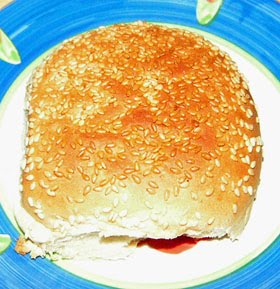
I often cook my burgers, though, in an iron frying pan. A griddle is usually used in a restaurant without an actual grill. Here is where the sesame seed bun can really reach greatness. After the burger is done, I take the buns and toast them top side down in some of the burger fat. This unleashes the wonderful nutty taste of the sesame seeds, and al
 so adds deliciousness to the bread. I recommend this method highly.
The last photo is not pretty, but it was delicious. It was a jalapeño cheeseburger, with a thick slice of raw onion, lettuce and mayonnaise. I split and cooked the peppers in the skillet with the burgers. The buns were toasted in the skillet after the burgers were cooked in it.
(What's the best way to assemble a hamburger?)
Monday, June 13, 2011
Fly
The superheroes of the comic books are known for flying. Yet upon reflection I find the list of those who fly is curiously short. I will try to compile a list here, and hope for some help to fill it out.
Superman. The premier of flight. We will include all Kryptonians such as Supergirl, Superman's dog Krypto, etc.
The Human Torch.
Green Lantern, with a magic ring. Or technological ring. See Arthur C. Clarke. Anyway.
A few simply have wings: The Angel of X-Men, and Hawkman, (and Hawkgirl, etc.) fly with wings.
I will get out of the way the pseudo-qualifiers:
Wonder Woman has an invisible airplane.
The Hulk "flies" by enormously strong leaps.
Iron Man has jets on his feet.
Thor "flies" by hurling his hammer, then catching the strap at the last second. Yes, it is sort of absurd.
The Atom is so small he is carried on wisps of air, or is subject to, and maneuvers around in, even subtler microscopic forces.
Dr. Strange seems to hover around lots. Usually in odd dimensions, but he can keep his feet off the ground. Using magic.
I am completely out of the loop on the more modern comix heroes. Sorry.
edit March 2016
I realize I quit reading comics in 1968, and have become more aware lately of my laughable incomplete survey.
Superman. The premier of flight. We will include all Kryptonians such as Supergirl, Superman's dog Krypto, etc.
The Human Torch.
Green Lantern, with a magic ring. Or technological ring. See Arthur C. Clarke. Anyway.
A few simply have wings: The Angel of X-Men, and Hawkman, (and Hawkgirl, etc.) fly with wings.
I will get out of the way the pseudo-qualifiers:
Wonder Woman has an invisible airplane.
The Hulk "flies" by enormously strong leaps.
Iron Man has jets on his feet.
Thor "flies" by hurling his hammer, then catching the strap at the last second. Yes, it is sort of absurd.
The Atom is so small he is carried on wisps of air, or is subject to, and maneuvers around in, even subtler microscopic forces.
Dr. Strange seems to hover around lots. Usually in odd dimensions, but he can keep his feet off the ground. Using magic.
I am completely out of the loop on the more modern comix heroes. Sorry.
edit March 2016
I realize I quit reading comics in 1968, and have become more aware lately of my laughable incomplete survey.
Tuesday, June 7, 2011
Mechanical Resistance to Esthetics of Intelligence
Progress along the long and difficult road to correctly designing a reading machine such as the Kindle has been beset by a continuous onslaught of negative paradigms. That ballast, that small percentage of critical mass that causes the ship to sink, is the general new-product-developers' ethos that includes this meme: they don't like to read.
As long as my devices are designed by teams which include people who don't like to read, they will not manage to design a device that satisfies me. Because I like to read. And significant percentages of their design teams possess an anti-intellectual ethos. Who'd have thought it?
They seem to be convinced that at every instant of my reading experience, somehow I would be happier watching cartoons, playing a mindless game, or listening to music or watching a TV show. Perhaps Twittering. The usual stuff marginally literate people do with the Internet. And when I occasionally have the advantage of easily identifying these people, they usually react like cockroaches exposed to the light, and begin scurrying. They scurry and hurl insults at me. They will shovel out a mass of implication, implying I am the oddball, I am the square peg, I am the loser.
This is from people who have insinuated themselves professionally into an industry, into designing a product based on reading, which they themselves don't really like. In short, illiterates run the boardroom.
So I still await the $45 portable reading tablet. It was basically invented 15 years ago, but you are not allowed to buy it.
As long as my devices are designed by teams which include people who don't like to read, they will not manage to design a device that satisfies me. Because I like to read. And significant percentages of their design teams possess an anti-intellectual ethos. Who'd have thought it?
They seem to be convinced that at every instant of my reading experience, somehow I would be happier watching cartoons, playing a mindless game, or listening to music or watching a TV show. Perhaps Twittering. The usual stuff marginally literate people do with the Internet. And when I occasionally have the advantage of easily identifying these people, they usually react like cockroaches exposed to the light, and begin scurrying. They scurry and hurl insults at me. They will shovel out a mass of implication, implying I am the oddball, I am the square peg, I am the loser.
This is from people who have insinuated themselves professionally into an industry, into designing a product based on reading, which they themselves don't really like. In short, illiterates run the boardroom.
So I still await the $45 portable reading tablet. It was basically invented 15 years ago, but you are not allowed to buy it.
Monday, May 30, 2011
Unidentified Snake
 I was not happy killing this snake, but it was large and the dogs have no sense about these things, so I did the dirty deed. It was, after all, quite large and most important, headed straight for the house.
The head is not in this picture.
The color and markings are so muddy and indistinct I am having a hard time identifying it. Help?
It was about 4½ feet long. 1½ inches diameter in the middle. Its head was not that triangular shape we have been told to notice.
Tuesday, May 17, 2011

Saturday, May 14, 2011
Mitt Graham

It has long seemed to me that Mitt Romney looks a lot like Billy Graham. So much so that I suspect some of the Republican base likes him a bit more than they would otherwise, subconsciously. A morph was born. I guess you can call him Billy Romney if you like.
sqirlz morph
Subscribe to:
Posts (Atom)