Butternut squash from volunteer plant. Got about eight this size from one plant. Most still on the vines.
Showing posts with label recipe. Show all posts
Showing posts with label recipe. Show all posts
Sunday, September 19, 2010
Volunteers of America
Butternut squash from volunteer plant. Got about eight this size from one plant. Most still on the vines.


Thursday, September 9, 2010
Pumpkin Pie for Grown-ups
 First off, I use butternut squash instead of "pumpkin" because I like it, and I have a large crop of huge butternuts in the garden this year. (There is also a smaller crop of Orange Hubbards which sprang up, like the butternut squash plant, as volunteer from the compost.)
This recipe includes two caramelized onions, and has half the sugar of many recipes. I made a whole wheat crust. I would rather use stone ground graham whole wheat flour, more like a typical graham cracker crust, but I had none and substituted whole wheat bread flour. Not perfect, but not bad either. I tried to not overwork it; I didn't want gluten to develop.
I chopped two onions and caramelized them overnight on "low" in my crock pot, which has "high" and "low" settings only. I added a pinch of salt and a pinch of sugar before beginning. They were the color of peanut butter by morning; just right.
- 3 cups butternut squash, peeled, cut up, and microwaved to softness
- ½ cup sugar, and enough molasses to make it into "brown sugar," about 2 tablespoonfuls.
- 1/4 teaspoon salt
- 1 egg plus 2 egg yolks, slightly beaten
- 1 cup milk with 1 cup of dry milk added to it
- 1/4 cup grated mozzarella cheese
- 1/4 cup (1/2 stick) melted butter
- 1/4 teaspoon of garam masala powder
I blended everything very well in the food processor except for the onions, which I then folded in by hand.
I don't like it when cinnamon, nutmeg, etc. overpower the delicate taste of the squash or pumpkin. I tried twice before I got the amount of garam masala low enough. Mine has ginger, clove, cinnamon, cardamom.
I made a crust from whole wheat flour, cold grated butter, cold water. Rested in refrigerator, rolled out, put it in buttered pie pan, and pre-cooked it for 7 minutes in a 375º F. oven. In a few minutes I then filled the crust with the filling. It was very full; a high dome of filling in the center stood an inch above the height of the edges of the crust. Afraid it would slowly flow, I put it in the oven immediately and baked it at 375º for 10 minutes, then 330º for 40 minutes. Perhaps 350º would have been better. It wasn't done in the center so I gave it another hour at 280º. Perfect top and crust.
This is a good pie for me and others who don't need overwhelming sweetness in a pie, yet want some little bit. The caramelized onion added some complex sugars too.
By the way, I roasted the reasonably large seeds in salt and butter after I cleaned the squash. A fine snack. I just chew the shells along with the seeds inside; they are tender enough. But that's just me.
Sunday, August 1, 2010
Cooking Perfect Tortillas
When I lived in south Texas I had flour tortillas lightly toasted on occasion, but most of the time they were taken and used cold from the package, and breakfast tacos, burritos, or fajitas assembled from them. I think the local distributors baked them just a tiny bit longer than some companies do, so they wouldn't really be "raw" tasting.
Incidentally, in Texas I saw few Mexican-Americans eat corn tortillas unless it was at Taco Bell. At regular restaurants, almost everyone had flour tortillas for bread. There, as you see in many Mexican restaurants, they are served in a covered bowl, lightly steamed. Kind of pasty to my taste.
It wasn't until North Carolina acquired a larger Mexican population that I experienced corn tortillas cooked on a griddle. The first time, I stopped at a restaurant that had tongue tacos - "lengua" - and ordered a plate. Each taco was served in two corn tortillas browned on their griddle. I was hooked.
At home, I soon tried to duplicate this but didn't have much luck. The corn tortillas, almost raw in their big bagged stacks (nice and inexpensive) from the regular groceries, which had began to stock them, got hard and leathery on my frying pan. Not good. So for a while I eschewed them and either fried my corn tortillas or ate flour tortillas.
Eventually I learned the trick. Here's how:
To make four tacos, since I was impressed with the double-wrap technique using corn tortillas, place a stack of eight on the griddle. I use a big cast iron frying pan. I also brush both sides of each tortilla with a little mix of a spoonful of water and some olive oil before I start. I don't want much oil, just a tiny bit. Place the entire stack of eight in the hot pan. On medium heat, the bottom-most corn tortilla, #1, browns on one side, just right. I flip the whole stack over with my spatula, keeping the stack lined up nicely, and begin browning tortilla #8. Then with my thumb and forefinger, I flip the done side of #1 which is now on top, over, exposing the uncooked side. When side a of #8 is browned, I flip the stack, begin browning side b of #1, and when it's done, flip the stack again, and brown side b of #8. At this point, like you, my mind begins to wander and - pay attention now!
At that point, I grab tortilla #1 and #2, and flip them both over. I then flip the whole stack again. #8 on top gets flipped along with #7. Now, both #1 and #8 are headed for the center of the stack.
So on, finishing #2 and #7, and then turning the top three. Bringing in turn #3 and #6 to the top and bottom of the stack. If you are counting, that's 16 flips to get them all. Note that if you cooked them one at a time, you would still have that same amount of flipping to do. The process of dealing them into the pan will be reduced to once.
The advantage to all this, is that as the stack begins heating up, you are steaming the tortillas. The browned portions of your stack, as they are moved towards the center, lose their leathery dry texture and become quite tender.
Eventually the last, tortillas #4 and #5, are browned on both sides. You are ready to remove the whole stack and stash it in a covered bowl and assemble your tacos, or fajitas, or what-have-you. (Slices of Texas-style slow cooked brisket come to mind.)
Once you master that, you can do your flour tortillas the same way. By the way, I never use a double-tortilla if it's a flour tortilla.
Incidentally, in Texas I saw few Mexican-Americans eat corn tortillas unless it was at Taco Bell. At regular restaurants, almost everyone had flour tortillas for bread. There, as you see in many Mexican restaurants, they are served in a covered bowl, lightly steamed. Kind of pasty to my taste.
It wasn't until North Carolina acquired a larger Mexican population that I experienced corn tortillas cooked on a griddle. The first time, I stopped at a restaurant that had tongue tacos - "lengua" - and ordered a plate. Each taco was served in two corn tortillas browned on their griddle. I was hooked.
At home, I soon tried to duplicate this but didn't have much luck. The corn tortillas, almost raw in their big bagged stacks (nice and inexpensive) from the regular groceries, which had began to stock them, got hard and leathery on my frying pan. Not good. So for a while I eschewed them and either fried my corn tortillas or ate flour tortillas.
Eventually I learned the trick. Here's how:
To make four tacos, since I was impressed with the double-wrap technique using corn tortillas, place a stack of eight on the griddle. I use a big cast iron frying pan. I also brush both sides of each tortilla with a little mix of a spoonful of water and some olive oil before I start. I don't want much oil, just a tiny bit.
 Place the entire stack of eight in the hot pan. On medium heat, the bottom-most corn tortilla, #1, browns on one side, just right. I flip the whole stack over with my spatula, keeping the stack lined up nicely, and begin browning tortilla #8. Then with my thumb and forefinger, I flip the done side of #1 which is now on top, over, exposing the uncooked side. When side a of #8 is browned, I flip the stack, begin browning side b of #1, and when it's done, flip the stack again, and brown side b of #8. At this point, like you, my mind begins to wander and - pay attention now!
At that point, I grab tortilla #1 and #2, and flip them both over. I then flip the whole stack again. #8 on top gets flipped along with #7. Now, both #1 and #8 are headed for the center of the stack.
So on, finishing #2 and #7, and then turning the top three. Bringing in turn #3 and #6 to the top and bottom of the stack. If you are counting, that's 16 flips to get them all. Note that if you cooked them one at a time, you would still have that same amount of flipping to do. The process of dealing them into the pan will be reduced to once.
The advantage to all this, is that as the stack begins heating up, you are steaming the tortillas. The browned portions of your stack, as they are moved towards the center, lose their leathery dry texture and become quite tender.
Eventually the last, tortillas #4 and #5, are browned on both sides. You are ready to remove the whole stack and stash it in a covered bowl and assemble your tacos, or fajitas, or what-have-you. (Slices of Texas-style slow cooked brisket come to mind.)
Once you master that, you can do your flour tortillas the same way. By the way, I never use a double-tortilla if it's a flour tortilla.
Tuesday, July 27, 2010
Return of More Shocking Dip
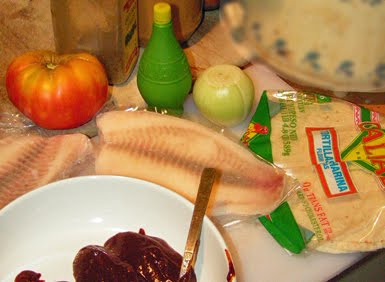
Homemade chili barbecue sauce is what I had in a glass jar with a metal lid, in the fridge.
A labor of love. I made it last week by cooking, after cleaning, a few different varieties of dried Southwestern-style chilies from cherry-sized to big, and onion, a trace of tomato in the form of ketchup; garlic and oregano and vinegar and mustard, with molasses. (The vinegar included some homemade vinegar I made from homemade Chilean red grape wine, which I made specifically from leftover grapes to make vinegar from.) I strained the sauce through a strainer after I pulverized it in the blender after cooking.
So that's what I dipped the tilapia in before breading it in half self-rising flour, half cornbread mix. With black pepper and some salt. And fried them golden brown in canola oil in the iron skillet.
On the side to fill the tacos with is a mix of fine slivered iceberg lettuce with an equal amount of fine slivered cabbage. With red vinegar and lime juice squirted on it, lightly salted right before adding it to the fresh Mr. Stripey tomato picked a few hours ago, washed, chopped lightly, and lightly salted. And a pile of similar sized avocado chunks, with salt and lime juice. And the chopped jalapeño.
Friday, July 9, 2010
Giant Squash


Here are some huge volunteer squash plants, likely offspring of butternut squash, which arose from the composted kitchen scraps. The leaves, however, I have only seen associated with pumpkin varieties, on the internet. I have not had much luck in the past with winter squashes, as they tend to sprout early and reach maturity far earlier than the recommended October harvest time. I don't see how varmints won't find these monsters before then.
What I have read says when the stem dies, then it's time to pick. Also they reportedly need a few weeks of aging after picking to reach maximum flavor. I can do that this time.
See some earlier posts on squash and pumpkins.
UPDATE: August 27 2010 They have all turned the delicate cream color they are supposed to be. I have eaten one, mostly, but still have pie remaining from it. The big one in the picture I harvested a few days ago, and it's hardening up in the kitchen.
Sunday, June 27, 2010
More Shocking Dip
For some frozen boneless tilapia fillets I made a standard sort of breading: half cornbread mix and half self-rising flour, augmented with salt, pepper, and some onion powder, and a healthy teaspoon of cayenne pepper.
Where I broke ranks with tradition is the dip I concocted to wet each fillet prior to applying the breading. I put 3 TBS. of yellow mustard, 2 TBS. of brown mustard, and a splash of beer - Sierra Nevada brand - into a bowl and whisked it up. It was a tad runny so I adjusted it with some sprinkles of the breading mix, whisking, until it was thick enough but not a "batter" by any means. Dipped, then breaded the fillets.
I heated an inch of canola oil in my cast iron dutch oven I use for a fryer, and fried the fillets to light brown perfection. Served with a squirt of lime juice on each. (On the side I had some sweet potato I skinned, baked in the microwave, and then thick sliced and browned each side in a skillet with butter. Also some baked beans from a can. What the heck.)
The fish is one of the best things I have had in a long, long time. Highly recommended.
Tuesday, June 8, 2010
Cherry Barbecue Sauce
Wash the 1/2 lb. of cherries. Pull the stems out, cut the cherries in half, and remove the stones. Add cherries and a bottle of Malta Goya (coke or pepsi if you have none of this, which you probably don't) and a teaspoon of sugar to a sauce pan and begin simmering. Add a bit of salt. Black pepper. Cut up a dry red New Mexico pepper, discard the seeds, and add pepper pieces to the sauce. Once it's all cooked down, simmering about 25 minutes at low heat, remove and drape the pieces of pepper over the pork loin. Pour the sauce and cooked cherries over pork loin and cook it all wrapped in foil as close to sous vide temperatures (140° F.) as your oven will go. Mine runs as low as 170° F. which I thought was too high for this but I cooked the loins for 8 hours.
Then early next morning I poured off the liquid, brought it back to a simmer, added some red wine vinegar - maybe a quarter cup - and the pieces of pepper, the cherry pieces, some onion powder, dash of cayenne powder, some minced garlic, a bit more salt, and finally a tablespoon of blackberry jam. And a tablespoon of some brown mustard. After simmering and some reduction again, I let it cool, pulverized the sauce in a blender, and ran it through a sieve, discarding what little remained after mashing it through with a a spatula, vigorously, back into the pan.
Before serving, brush some sauce on, brown the outsides of the already cooked pork loin, either on a very hot grill or on a hot skillet, then remove, slice, and pour a dollop of the remaining sauce over it.
Wednesday, May 5, 2010
More More Malt
Recently made some chili, as I noted in a previous post. Having one of those bottles of Malta Goya on hand, and being familiar with the practice of using beer as the added liquid in some chili recipes, and also being familiar with a bit of sugar in some recipes to balance the bitterness of large amounts of hot chilies, which I do love, I decided to use the malty sweet barley drink as base of that particular batch. All I can say is, it was perfect.
More posts about malt in cooking.
More posts about malt in cooking.
Thursday, January 21, 2010
Let Them Eat Snakes
The Food Network has decided to broadcast "competitive cooking" for much of its entire programming day. This is colossally stupid.
Competitive cooking was fun, new, and freakish the first few times because it was rare. But doing it all the time is wrong on several levels.
Cooking is peaceful, intelligent, sentimental, delicious, interesting, primal, and fun. Often honest. Not a competition. Competitive cooking is almost a parody of what the stereotypical "moronic male" would do to a cooking channel: ruin it.
And then there are the cakes. I can't stand the shows about these cakes. These horrible, horrible cakes, made out of sugar and industrial foodlike substances. Every cake is a monument to the systematic denial of food to a starving child somewhere overseas. True abomination.
So to Hell with the Food Network, and I mean that literally.
Sunday, January 3, 2010
Posole - Corny Story Part II

When I first made hominy and then masa dough for tamales out of the hominy (see Corny Story), I had fun and it was delicious. Not wanting to trek around in strangers' cornfields, this time I sought a source of dried field corn for sale close to home.
I made a few calls and couldn't find any wholesale yellow corn for sale. Finally I recalled that a local outfit sold corn stoves, and I called them and they said they had 50 lb. bags of corn for fuel. I meant to go by there and get some.
But the other day at the hardware store, the real old one that has outlasted the pressures imposed by the Home Depot and Lowes, I was getting my purchases together and noticed a man inquiring about the "deer corn" they sold. So I said I'd get a 50 lb. bag of it. The price was $10. Note that comes out to 20 cents per pound, which is a whole lot less than a pound of corn flakes, for instance, and a lot less than a pound of masa meal. And then I heard the other customer gripe that he didn't want a whole fifty pounds. "I'll split it with you," I offered and he quickly agreed. We asked for a bag and got a trash bag from the proprietor, and I had a stronger bag in my truck. Jay (we shook hands and introduced ourselves) and I split it up in front of the hardware store. He said he lived down in South Carolina and wanted it for luring deer so his family could bag some venison.
Back home, I called the company in Georgia that wholesaled it, and told a lady I was a writer doing an experiment making hominy and if it was safe to eat (I figured it was, but there are overturned trucks on the interstate, and salvage operations, or resales after freak contamination events and things like that, and I wanted to be sure.) She was interested and called me back after telling her bosses about my request, telling me they assured her it was safe to eat, it being just corn.

I took about a half gallon and rinsed it well, and began soaking it. I changed the water a couple of times and let it soak about 28 hours. Then I made hominy. And like last time, it took longer than the internet sources I read said it would. Simmered in lime water, then another soak overnight in it, and next morning it was still tough so I began simmering it again. I had to add water two more times; it kept swelling above the waterline in my big stainless steel pot. Finally I had to transfer it to the Big Pot, my new four-gallon stainless steel baby. After another two or three hours simmering it was done. Then I rinsed it and rinsed it, removing the limewater.
I have to note that my hominy still had the skins attached. There was one article that said you could cut the little cob end off each grain by hand and they'd come off easier. Yeah, right! But I didn't take them off last time and it was still good then.
Then, following this recipe at one of my favorite food sites, Homesick Texan, I made posole, a Mexican pork and hominy soup. I used bacon and pork loin cubes instead of pork shoulder and ham hock. Everything else was the same. Delicious! The soup was so flavorful I added more hominy than she did and it was just right. I served it with julienned scallions and cilantro.
Here's the leftover hominy, soon to be ground into masa dough for tamales in a few days. It should keep
 in the refrigerator for a week. It's hard to tell but each of these grains is about twice as wide as it originally was.
Update 5-5-10 The chewyness of the unseparated corn hulls finally got to me, as I froze several servings separately and reheated later. However, this has led me to re-introduce myself to several brands of store-bought hominy such as Bush's, and theirs is very good. I'll save the homemade for when the Apocalypse comes around, or find a correct corn variety (more likely, as the first time I made hominy it was better.) In any case, I liquefied the last batch of thawed-out posole in my blender and made a fine chili out of it, adding in the extra ingredients along with ground beef. Sure made a great chili.
Update 2: August 2010 I haven't made it clear, but the first time I did this using the field corn I picked myself, I had a better result. The deer corn was of lower quality overall. This taught me the difference between low- and high-quality dried corn, anyway. Next time, I'll go for some field corn from a local guy who has agreed to hook me up with some of his own he grows.
Tuesday, December 29, 2009
Thai Soup

One TBS. miso paste
One TBS. chicken boullion
Quart of water
One TBS. garlic
One can coconut milk
One half a dried Thai pepper
One tsp. dried ginger powder
salt, MSG
Grated peel of one lime.
Simmer.
Juice of half a lemon, and half the lime, added right before serving.
Garnished with cilantro and julienned scallions.
Success! Delicious. Think I'll have another bowl.
This is a fine base for adding other things. I'm thinking shrimp. Or, for another taste, peanut butter. Which I have here now.
(With all the citrus, when I put a dab of peanut butter in the leftovers next day, it unbalanced the flavors. I would suggest saving the peanut butter for another recipe.)
Update: 2-21-10 I recreated the soup and this time added some shrimp which I first boiled, in a spicy bath comprising Old Bay seasoning, a little lime juice, and a few grams of Dave's Insanity Sauce in salted water, for two-and-a-half minutes. Then I put them in a salted ice water bath. Then I drained them and peeled them later. When the soup was ready I put them in just long enough to get hot. Served this time too with scallions and cilantro and lemon and lime juice added right before serving.
Update: 4-27-10 Again I made this same basic recipe. I omitted some of the citrus juice but this time added some roast chicken meat I had pulled off the bone, and a couple of tablespoons of adobo sauce, which comes packaged with sesame oil. Delicioso! (not pictured here; the photo is of the shrimp version, my second selection.)

Monday, December 21, 2009
Mediterranean Wintertime Fish

Hearing some descriptions of a dish from my sister, I promptly forgot the recipe except for a few themes, and created this.
(To warn you right away, this is the story of a failure.)
Sautéed two chopped small onions and stalk of celery, two pinches of whole mustard seeds, 1/4 jalapeño in a skillet I had just fried two pieces of bacon in, reserving some of the bacon fat for later endeavors.
Then, once that began to brown, I added a couple of spoonfuls of water, a tin of anchovies and broke that up in the center of the sauté pan, and 1 TBS. each of minced garlic and capers. This simmered about 8 minutes and the anchovies pretty much dissolved.
 I added a tin of sardines (3 in the tin) and a handful of chopped arugula, the cooked crumbled bacon, and a can of clams, drained. I decided to add some thyme and black pepper. I put the lid on and simmered this for maybe 3 minutes, wanting the clams piping hot but not cooked any longer. I added a cup of heavy cream, put the lid on, turned off the stove, and cooked my pasta, some farfalle, also known as "bow ties."
 Could have used some more cream. In fact, it would have benefited by leaving out the capers, replacing the sardines with some other fish. Parsley would have worked better than arugula. Come to think of it, tomatoes would have been better than cream. And the sardines were the wrong kind. Mustard sauce. I rinsed them but really, I should have left them out today.
This recipe needs work. A lot of work. Verdict: minor failure. It was good food, but the flavors were not balanced.
Friday, December 11, 2009
More Malt
Today being a cold one, I loaded up the stove with wood and cooked myself a big pot of oatmeal, and when it was done I poured malt syrup all over it and dug in. Delicious!
I started out when young putting brown sugar on my oatmeal. That trick, which more people ought to know, lifts oatmeal into the realm of excellence. Later, when I learned that brown sugar is just a premixed blend of granulated sugar and molasses, I just began buying molasses. And putting that on my oatmeal. I also make my oatmeal with milk instead of water.
I have also tried maple syrup on the oatmeal, and that's pretty good. But today the malt syrup went on there. I pronounce it a success. It rivals my favorite, the molasses. Call it a tie.
This is part of a slowly evolving series I'm doing about cooking with malt. You can use the handy-dandy search box to find all my articles about "malt."
Friday, December 4, 2009
Unnatural!!!

Every so often I hear some smug holier-than-thou type telling me it's unnatural to drink milk. I drink milk, and they don't: ergo, they are superior beings.
Without fail I notice these people eat cheese. Which, I must point out, is one step further removed from "natural." Not only are they harvesting hetero-species-ical milk, they are curdling and aging it and allowing bacteria and mold grow in it. So how natural is that, Mr. and Ms. Natural?
Granted, I'm not happy with the growth hormones and such in modern milk. And I even sympathize with vegans. Still, that's not what these kooks are talking about.
Plus, they act like they are somehow "grown up" which is why they eschew milk. You and I both know these people wouldn't drink milk even when they were kids, causing their mothers' to worry about their diets and give them Bosco and Ovaltine and stuff normal kids never had to learn about. Which worries were justified, because now that they are all grown up they live on diets mostly of coffee, booze, chocolate, cigarettes, soda pop and pizza. Grown up food. You know, the natural way of doing things.
I hope their hips don't shatter. Must be tough eating that required half-pound of collard greens per day to get the calcium. What with their preferred diet. Oh, wait, that's right: they eat the cheese. Lots and lots of cheese.
Here is a being acting naturally. I'm not so sure about this or this, but live and let live: that's my motto.
Paneer Breakfast
 Deciding on an attempt to eat a healthy breakfast, I knew veggies were paramount. I know this puts me at odds, in general, with most of the U.S., for whom breakfast vegetables are usually limited to potatoes, onions, and, rarely, to what is included in a Spanish omelet - tomatoes and peppers and such. And of course, a bean breakfast burrito. Or the mushrooms, or spinach in other kinds of omelet. All of which is starting to sound not too awful, actually. All right, I surrender: there are more healthy options to American breakfast than I realized.
Anyway, I had some paneer left over. I made it using this recipe from The Paupered Chef. Using the sour milk (yogurt, actually) to curdle the fresh milk was a clever trick which, although thousands of years old, had eluded me. When I made it, I used it in an eggplant and potato dish, but didn't document any of it.
But for today I planned this breakfast dish last night and early this morning, and fine tuned it as I made it. Here's what we have:
One last poblano from the garden, a small green one the size of a big jalapeño; and a small onion, chopped and begun browning in butter. Meanwhile, I began heating a 6" iron skillet to toast some spices in. But first I measured out a half teaspoon each of mustard seed and cumin seed, and tossed that in with the cooking onions. Then I measured out the following:
1/2 a dried Thai red pepper, chopped
1 tsp commercial garam masala powder (this has some cinnamon in it.)
1 tsp turmeric powder
1/2 tsp fennel seeds
1/4 tsp fenugreek seeds
6-7 black pepper corns
2 cloves
5-6 cardamoms
1/2 tsp coriander seeds
and toasted it in my little skillet. I kept it moving and tossing; the turmeric and garam masala powder needed the toasting most but was most likely to burn first, so I watched it. Then I emptied my little skillet full of toasted spices into a coffee cup, and as soon as it cooled I ground everything into a spice mix in my coffee mill / spice grinder.
Before it cooled, I had diced up the leftover paneer - a chunk about as big as a tennis ball- and begun browning it. And then added the generous handful of frozen green peas. Stirred in those spices. And finally, some diced leftover sweet potato which had been made the previous evening with a sprinkle of sugar and drizzle of molasses (which equals "brown sugar;" I usually make my own when I need it.)
I stirred for a few minutes, wanting everything to brown just lightly, and when it had I added a splash of water, a little salt, and it was done in another minute.
If you want some Indian recipes, check out Tigers & Strawberries, one of my favorite food sites.
There are some paneer options I've just begun to ponder, such as adding heavy cream for a richer paneer. I could have made my own yogurt, too. Sometimes I'll buy some and start a batch with one spoonful of the store-bought mixed in a quart of milk.
Milk used to be more heavily subsidized in this country. Dried milk used to be substantially cheaper than whole milk. Still, money can be saved if it's bought in the big sizes and I'll champion homemade yogurt made from dried milk as being good as any other.
Wednesday, November 18, 2009
Shocking Dip Part 2 - Szechuan Sauce for Breading Chicken

Last night, continuing this train of thought, I dipped some chicken in Szechuan sauce before I applied my mix of pankoesque crumbs with flour, salt, pepper and a tad of cornbread mix. I used a different brand than Kame, because I can't find it around. A good Szechuan sauce is fermented all together, in my opinion. It has soy and hot red pepper flakes or powders, and also other flavorings such as plum, garlic, ginger, sesame. I'm no expert on how to make these sauces; all I know is the brand Kame sold a few years ago was really good. I think they changed the recipe; it was not available for a few years and then all of a sudden I saw it again. Just not lately. So I used Asian Gourmet brand Szechuan stir fry sauce.
This made very tasty fried chicken. It almost browned too fast but I turned down the heat, and kept flipping it in the pan, and let it finish on low. I may never dip chicken in egg dip again.
Sunday, November 15, 2009
Malted Chocolate Ice Cream

This is another example of using malted barley syrup for uses other than making beer. Here I poured some "amber" malt syrup over some chocolate ice cream. No hops in this syrup, of course.
Malt seems to be a big mystery to lots of people. It used to be sold as syrups more widely. All I can say is follow the malt link and learn. It's widely used in the mass-produced candy market, but no longer a common home ingredient. A malted milkshake is a milkshake with malt syrup or dry malt powder added.
It's a similar taste to caramel, but it is distinctly itself, a different flavor of sweet. It's often blended with caramel sugar, and can be caramelized itself.
"Malted milk" powder is a bit different. It's malt sugar mixed with dry milk powder. And wheat, apparently. I say, why pay for the part that's dry milk when I already have my own milk and ice cream to mix with the pure malt sugar and syrups?
Some use pure malt to sweeten waffle and pancake batter. I think it would make a great syrup on waffles and pancakes. Or both in the batter and on top. It's also used to provide a boost to yeast in breads and rolls.
Before sugar cane or sugar beets, it was known and available as a sweetener in Europe and surrounding parts. I don't know if it was widely used that way much historically. It would take extra fuel to extract pure sugar syrup or crystaline powdered malt sugar. Beer would be easier to make from malted grains.
Here's a link to beer making.
A short orientation about sweets in the Middle Ages.
Maltose.
Oh, the ice cream was delicious.
Sunday, November 8, 2009
Tamale Pie
 (The photo was taken right before I put it in the oven)
There are several variations of "hot tamale pie" to be found on the internet. Lots of them seem to have bell pepper and most don't use masa. Some criticize it for being "inauthentic."
It has a lot of similarities to a Cuban traditional dish, a pork and cornmeal stew.
In any case, here is mine:
I basically made a recipe of chili con carne, using 1¼ lbs. of hamburger and a little bit - 4 oz.? - of smoked salt pork I had.
No beans. Instead of beans, it uses whole corn. Read further.
I use dried Mexican savory peppers and add cumin, garlic, and oregano instead of buying commercial chili powder to season it. You can heat it up to your level of fire using different hot sauce or hot peppers in addition. I find this recipe benefits from a large dose of black pepper, also. To me it complements the corn flavor.
The recipe then departs further from traditional chili. In this 1½ gal. batch, I then added half a can of corn and 1½ cans of creamed corn and a cup of milk. I made the tomato-y part with tomato paste but I added a 16 oz. can of whole tomatoes. Then I added a whole cup of masa harina, which will thicken it up far more than a regular sort of chili. I prefer yellow masa, aka maize amarillo. It is not as common as white corn masa. (This bugs me. The white corn people are cramping my style. ¡Viva maíz amarillo!)
After it all comes to a boil and then simmers a while on a lower heat, and the masa is fully cooked (about 10 minutes), I cut up a pound of Monterey Jack cheese with peppers in it - "pepper jack." I stuck the slices down into the stew. Then I put that in the 265º F. oven until the top browned just slightly, about 25 minutes. Turned off the oven, cracked the door, let it rest for 15 minutes, and served.
Saturday, October 31, 2009
Malty Glaze

Malta Goya is a beverage made from malt sugar and carbonated water and hops. It's an odd variety of soda pop not familiar to most in the U.S. but sold in several other countries. There's no alcohol in it but if you opened it and added yeast it would turn into beer. Before it's converted to alcohol, malt sugar has a flavor in addition to its sweetness. (It's the flavor of Grape Nuts cereal, as a matter of fact, which is toasted malted barley and has nothing to do with grapes or nuts.) It is that often hard to define (until now!) flavor that makes a malted milk shake taste different from a non-malted milk shake.
Since I wanted to taste this, I bought some recently. I don't drink many Cokes or Pepsi or drinks like that, and the Malta Goya tastes a bit like a cola but the malt flavor is too much for me even though I like that flavor, if that makes any sense. I also realized I could cook with it, and although I would just as well buy some malt sugar from the beer-making supply store, this was on the shelf of the grocery store where I was.
One of my back-burner projects is figure out if malt sugar is just the right kind of sugar for any particular dishes so today when it was time to glaze this ham I popped open a bottle and reduced it down to a thin syrup on the stove. I added a teaspoonful of prepared mustard and glazed the ham, which had cloves stuck in the centers of the scored fat squares. After the final half-hour in the oven the glaze was just right and the ham done.
It made a very tasty glaze; my instincts were good. It gets competition from maple syrup, honey, molasses, caramel - all respectable contenders for tasty ham glazes. This malt glaze should at least puzzle some sophisticates, provide some conversation and please the palates of some pretty persnickity people.
As I was finishing this article I thought of making an ice-cream soda or float with Malta Goya. The hops in it might foil that plan. Would any flavor ice cream soda work with the hops? Pineapple sherbet? Goya has a suggestion.
I really wish my local "health" food store carried malt sugar... without the hops.
I think I just have to drive out to the beer supply place and buy some malt sugar and maybe some malt syrup. That's where I got some a year or so ago for homemade malted milkshakes. Rather than search for Carnation Malted Milk I will purchase my own milk, thank you, and add malt sugar to my milk - or my chocolate ice cream - or my waffle batter - as needed. I think that will be best.
A product I never tried, Ovaltine, is supposed to be an amalgam of malt sugar and dry milk, plus vitamins and dried eggs or something along those lines. I will pass on that as well.
All this is making me think of adding malt sugar to certain smoothie recipes.
And one of these days I will make some more beer with it, which is what most people use it for in the first place!
Saturday, October 24, 2009
Squash or Pumpkin - Squmpkin?
 An orange Hubbard. About 6" across, 7" from stem to stern.
I plan on roasting this particular calabash like any winter squash, and have it with maybe a pat of butter. I want to taste it pretty much plain, to analyze the flavor.
 UPDATE: On the left, just after I cut it. (I saved the seeds, incidentally, removed and washed the pulp off, and toasted / roasted them in the toaster oven with butter and salt. As always the husk is pure roughage but the seed inside is tasty and nutritious.) On the right, after I cooked it in foil for about 35 minutes in a 350º F. oven.
This tastes good. It rivals a very good butternut squash and was better, and oranger, than the average butternut squash that is usually available lately. More beta carotene never hurt. I had half of it with a pat of butter; no salt. (I'm usually a salt-user.) This squmpkin would make a very good pie. Thumbs up!
Subscribe to:
Posts (Atom)